
Every week in my practice, the same scene plays out. A patient comes in glowing — she's down 25, 35, sometimes 50 pounds on her GLP-1 protocol. Her bloodwork looks better than it has in a decade. And then, when I ask how she's feeling, her voice drops. She tells me she hasn't had a normal bowel movement in five days. That her stomach is so bloated by dinner she has to secretly unbutton her jeans at the table. That she's been swallowing back sulfur burps in meetings that taste like rotten eggs.
Then she says the sentence I hear most often: “I've tried everything my doctor told me to do — and it's getting worse.”

She's drinking 80 to 100 ounces of water a day. She's taking Metamucil religiously. She's on Miralax every single morning, sometimes twice. She's eating clean, tracking her protein, doing everything “right.” And she is still in pain, still backed up, still terrified that something inside her is permanently broken.
I want to tell you what I tell her: nothing about this is your fault — and almost everything you've been told to do for it was designed for a different problem.
GLP-1 medications like semaglutide and tirzepatide work, in part, by deliberately slowing your digestive tract. That's not a malfunction — it's the mechanism. The drug delays gastric emptying so you stay full longer and eat less. But in a meaningful percentage of patients — especially women over 40, whose gut motility is already slowing from declining estrogen — that “delay” tips over into something much more severe: a digestive system that has effectively stopped moving.
When food stops moving, everything you're experiencing follows with mechanical inevitability. Food sits in the stomach and ferments — that's the sulfur burps. Gas builds behind the stalled contents — that's the evening bloat. The colon keeps extracting water from waste that isn't going anywhere — that's how stool turns to concrete. And adding bulk-forming fiber to a pipeline that isn't moving doesn't push things through. It packs the jam tighter.
“The patients who suffer longest are the ones treating five separate symptoms — a Tums for the burps, a Miralax for the constipation, a Gas-X for the bloat. The patients who recover are the ones who realize it was never five problems. It's one problem: food that has stopped moving.”
Below are the five warning signs I tell every GLP-1 patient to watch for. They matter because they distinguish drug-induced digestive shutdown from ordinary constipation, “menopause belly,” or a bad diet — three labels you've probably already been dismissed with. If you find yourself nodding along to two or more of these, the advice you've been following isn't just failing you. It's working against you.

Fiber and water make your bloating worse — not better
This is the single most reliable sign that what you have is not ordinary constipation. In a normally functioning gut, bulk-forming fiber absorbs water, expands, and stimulates the muscular contractions that move everything along. That's why it's the first thing every doctor recommends.
But fiber only works if the pipeline is moving. In a gut slowed to a near-stop by a GLP-1, that same expanding bulk has nowhere to go. It absorbs water, swells, and sits — compacting against everything behind it. Patients describe the result with brutal accuracy: “rocks in my stomach,” “cement,” a “traffic jam” that gets worse the more they follow the advice.
If every dose of Metamucil leaves you more bloated, more gassy, and more stuck than before — that is not a hydration failure on your part. That is the signature of a paralyzed pipeline being loaded with bulk.

Sulfur burps that taste like rotten eggs — hours after you ate
Ordinary indigestion produces burps shortly after a meal. GLP-1 sulfur burps are different: they erupt hours later, often out of nowhere, with a foul, eggy taste that patients describe as “rotting food” — because that is, quite literally, what it is.
When gastric emptying is delayed, food that should have left your stomach in one to two hours can sit there for four, six, eight hours or more. Warm, stationary, half-digested food doesn't wait politely. It ferments. The bacteria working on it release hydrogen sulfide gas — the same compound that gives rotten eggs their smell — and that gas has only one direction to escape: up.
No antacid fixes this, because acid was never the problem. The problem is food sitting still long enough to spoil inside you.

You're full after three bites — and the food “sits like a brick” all night
Some appetite suppression is the point of the medication. But there's a difference between feeling satisfied sooner and feeling like a small piece of chicken has turned to concrete behind your sternum for the rest of the evening.
When the stomach's churning and emptying slow dramatically, even modest meals stack up with nowhere to go. Patients tell me they sit at the dinner table doing silent math: if I take one more bite, will I pay for it at 10 PM with reflux, nausea, or burps? Many begin quietly fearing food itself — skipping meals not because they aren't hungry, but because they're afraid of what eating will set off.
If meals have started to feel like a risk calculation rather than nourishment, your stomach isn't emptying — it's stockpiling.

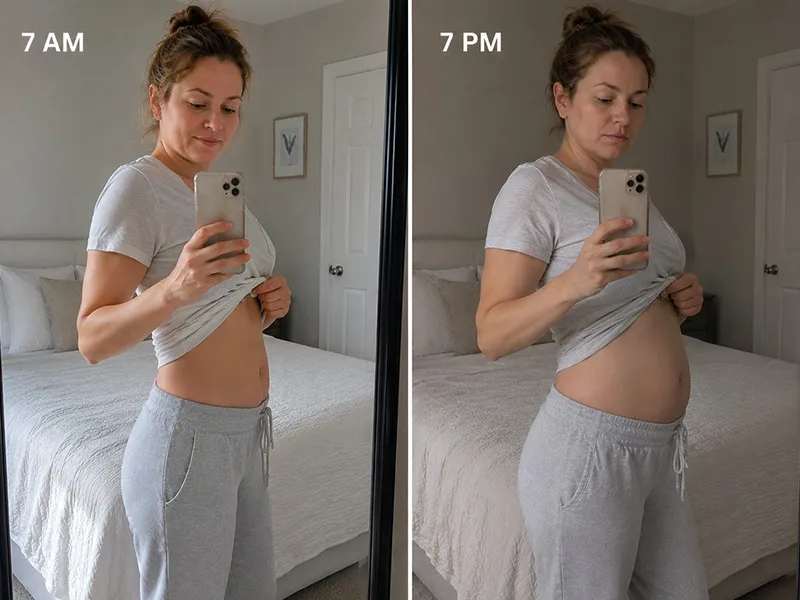
Flat in the morning, “five months pregnant” by dinner — while the scale keeps dropping
This is the cruelest sign, because it attacks the very reason you started the medication. The scale says you're losing weight — and you are. But by 7 PM your lower belly is so distended that the jeans that fit perfectly at breakfast are cutting into you, and you're unbuttoning them under a napkin at the restaurant.
Ordinary “menopause belly” is fat distribution — it's the same in the morning as it is at night. What you're experiencing is different: a progressive, day-long inflation. Every hour that food sits stationary in your digestive tract, fermentation gas accumulates behind it with no exit route. By evening, you're carrying an entire day's worth of trapped gas above an entire week's worth of backed-up waste.
If your bloat builds through the day and visibly deflates only after you finally pass something — that's not body fat and it's not your hormones. That's pressure behind a blockage.

Laxatives either do nothing for days — or strike violently without warning
In a normal gut, an osmotic laxative like Miralax works on a fairly predictable schedule. In a GLP-1-slowed gut, the rules break. The laxative travels through a pipeline moving at a fraction of normal speed — so it can sit, ineffective, for one, two, three days. Then, with almost no warning, it hits a system holding several days of accumulated waste, and the result is sudden, violent, and completely unpredictable.
My patients call it “laxative roulette.” They map every bathroom between home and the office. They've abandoned shopping carts mid-aisle. Some won't take their dose on workdays at all — choosing to stay impacted rather than risk a public emergency.
If your relationship with laxatives has become a gamble between “nothing happens” and “everything happens at once,” the laxative isn't the problem. It's being asked to fix the wrong end of the system.
“Your GLP-1 is not damaging your gut. It is doing exactly what it was designed to do — slow everything down. The mistake is treating a deliberately slowed system as if it were a broken one. Those need opposite solutions.”
Why everything you've already tried has failed — or backfired
If you recognized yourself in the signs above, you've almost certainly already spent money trying to fix this. Here's the uncomfortable truth: the remedies most women reach for were all designed for a normally moving digestive tract. Used on a pharmacologically slowed one, they don't just underperform — several of them actively make the problem worse.
| What you tried | Why it fails in a GLP-1-slowed gut |
|---|---|
| Metamucil / fiber supplements | Bulk-forming fiber needs muscular movement to work. In a stalled gut, it expands and compacts — like pouring wet concrete into a stopped traffic jam. This is why your bloating spikes after every “healthy” dose. |
| Daily Miralax & stimulant laxatives | Laxatives act at the very end of the pipeline — the colon — while the backup begins at the very start, in a stomach that won't empty. They can't prevent the jam; they can only blast it out after days of accumulation, which is exactly the “roulette” pattern you've been living. |
| Tums, Pepcid & acid reducers | Stomach acid is a primary trigger for the stomach to empty its contents downstream. Suppressing it slows emptying even further — so the antacid you take for the burps quietly extends the exact stagnation that causes them. |
| Grocery-store probiotic gummies | Generic probiotics are formulated for everyday “gut wellness” in an unmedicated digestive tract. They do nothing to break down the food sitting in your stomach right now — which is where this entire cascade begins. |
| “Drink more water” | Hydration matters, but it cannot restart a pharmacologically slowed pipeline — and with a stomach that empties slowly, most women physically can't get the recommended volume down anyway. If water were the answer, your 100 ounces a day would have solved this months ago. |
Notice the pattern: every one of these tries to push harder on a system that cannot push back, or treats one isolated symptom while the root cause — food stalling at the top of the pipeline — goes completely unaddressed.
Delayed gastric emptying is a documented, intended pharmacological effect of GLP-1 receptor agonists — it is part of how the medications produce satiety and weight loss. A widely cited 2023 study published in JAMA found that patients using GLP-1 medications for weight loss had a significantly elevated risk of gastroparesis (stomach paralysis) and bowel obstruction compared to other weight-loss medications.
In other words: the “digestive shutdown” pattern described in this article is not anecdotal, and it is not in your head. It is a recognized clinical consequence of the same mechanism that makes these medications effective — and it requires a solution designed for a slowed system, not a normal one.
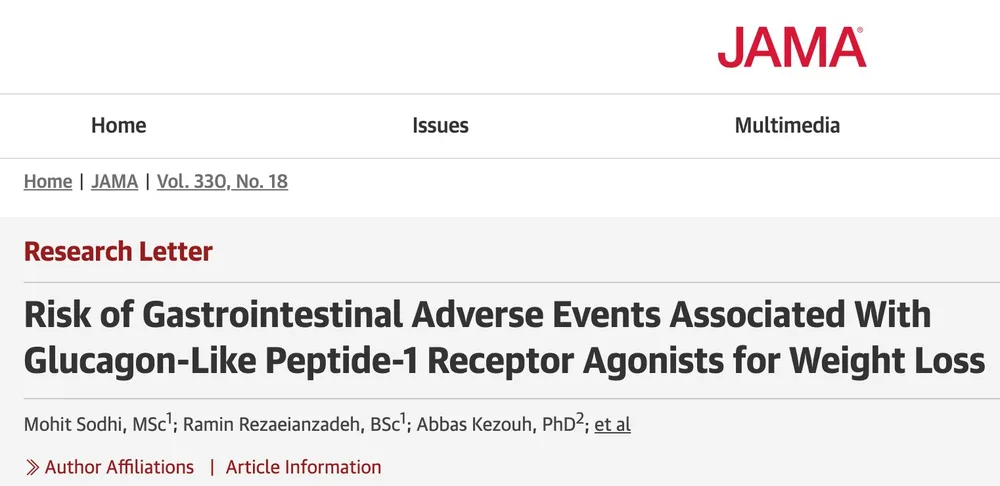
Sodhi et al., JAMA, 2023 · jamanetwork.com — independent research; the authors are not affiliated with any supplement brand.
The Metabolic Motility Reset: the four-part method that actually addresses GLP-1 digestive shutdown
Here is the reframe that changes everything for my patients. You cannot force a paralyzed pipeline to move faster — the medication is in control of that, and attacking the medication means giving up the weight loss you've fought for. What you can change is the state of the food traveling through it.
A large, intact bolus of food stalls, ferments, and compacts. The same meal, broken down early and thoroughly into a near-liquid state, glides through a slow system with dramatically less resistance — no fermentation backlog at the top, no concrete formation at the bottom. The goal isn't to speed up your gut. It's to give your gut less work per inch of pipeline.
I call this approach the Metabolic Motility Reset: four things working in sequence to do the digestive work your slowed gut can't. This exact sequence is what's missing from every generic gut supplement on the shelf:
Enzymatic breakdown — dissolving food before it can stall
A full-spectrum digestive enzyme complex (proteases, lipases, amylases) acts as chemical scissors, cleaving proteins, fats, and starches while the food is still in the stomach — doing the mechanical work your slowed stomach can no longer do on schedule. Food that's already liquefied can't sit and rot.
Acidic priming — restoring the “empty” signal
An adequately acidic stomach environment is one of the body's natural triggers for emptying contents downstream and keeping the esophageal valve sealed. Apple cider vinegar supports that acidic environment — the opposite strategy of the antacids that have been quietly prolonging your stagnation.
Prebiotic support — feeding the workforce, not the blockage
Unlike bulk fiber, targeted prebiotics don't expand in the pipeline. They selectively feed the beneficial bacteria in the lower gut — the colonies responsible for water balance and the lubrication of waste as it moves through a slowed colon.
Probiotic repopulation — rebalancing a slowed ecosystem
Stagnant digestive environments favor gas-producing, sluggish bacterial strains. Reintroducing beneficial strains helps restore the osmotic balance the colon needs to form and pass stool comfortably — without stimulant chemicals forcing contractions.
Notice what the Metabolic Motility Reset does not include: no bulk fiber, no stimulant laxatives like senna, no acid suppression. Nothing that pushes, forces, or fights the medication. It simply does the digestive work, in advance, that the GLP-1 has told your body to postpone.
Vital Gut Health: the Metabolic Motility Reset in a single daily protocol
For a long time, I had nothing complete to offer these patients — I was piecing together separate enzymes, separate probiotics, separate routines, and watching compliance fall apart. What I needed was the full four-part sequence in one protocol, with no stimulants and nothing that interferes with the medication. Vital Gut Health is the formula I evaluated as a clinician, trialed with my own patients, and now recommend — because it was engineered around this exact mechanism rather than generic “gut wellness.”






Vital Gut Health — the 4-in-1 Metabolic Motility Reset
The only formula I've found that delivers the complete Metabolic Motility Reset in a single daily protocol — enzymatic breakdown, acidic priming, and microbiome restoration, addressing the GLP-1 digestive cascade at its source.
Try It Risk-Free →Full-Spectrum Digestive Enzymes
The differentiating component. Proteases, amylases, and lipases begin dissolving proteins, starches, and fats the moment food enters the stomach — preventing the stagnation-and-fermentation cycle behind the sulfur burps, the brick feeling, and the downstream concrete. This is the mechanism GLP-1 digestion specifically requires, and the one missing from nearly every mainstream gut supplement.
Apple Cider Vinegar
Counterintuitive — and that's the point. Adequate stomach acidity supports the natural emptying signal and proper valve function. For women who've been chewing Tums against the burps, this is the reversal of a strategy that was quietly working against them.
Targeted Prebiotics
Selectively nourishes the beneficial bacterial colonies that govern water balance and lubrication in the lower gut. Unlike Metamucil-style bulk fiber, prebiotics don't expand inside a stalled pipeline.
Live Probiotic Strains
Repopulates the gut with beneficial strains that out-compete the gas-producing bacteria that thrive in stagnant environments — supporting comfortable, regular movements without a single stimulant chemical.
What's deliberately NOT in it
Nothing that forces contractions, nothing that expands in transit, nothing that suppresses acid, and nothing known to interfere with semaglutide or tirzepatide. It works with the slowed system — never against the medication.
Two capsules daily, taken before your largest meal. GMP-certified US facility. Third-party tested. Vegetable capsule.
What consistent use delivers

End the backlog before it starts
Food broken down early can't compact into the days-long backups that have been ruling your week — the problem is addressed at the top of the pipeline, not blasted out at the bottom.

Quiet the sulfur burps
Food that's enzymatically dissolved instead of sitting whole has far less opportunity to ferment — cutting off the rotten-egg gas at its source.

Deflate the evening bloat
Less stagnation means less day-long gas accumulation — so the body you see at dinner matches the one you earned on the scale that morning.

Regularity without roulette
A predictable, comfortable rhythm — without stimulant laxatives, without the gamble, and without mapping every bathroom between home and the office.
Why Vital Gut Health leads the category
| Vital Gut Health | Generic gut brands | |
|---|---|---|
| Built for GLP-1-slowed digestion | ✓ | ✗ |
| Full-spectrum digestive enzymes | ✓ | Rare |
| ACV acidic-priming component | ✓ | ✗ |
| Prebiotic + probiotic sequence | ✓ | Partial |
| Zero stimulant laxatives | ✓ | Varies |
| GMP-certified US facility | ✓ | Varies |
| 60-day money-back guarantee | ✓ | Varies |
The results are nothing short of astonishing
Taking Vital Gut Health consistently delivers more than physical relief — patients report sitting down to dinner without doing silent math, leaving the house without mapping bathrooms, wearing their hard-earned smaller sizes through the evening, and a sense of control over their own body they thought the medication had taken from them.
What GLP-1 users are saying
I'm fourteen months into Wegovy and the constipation nearly made me quit a medication that was finally working. I was on Miralax twice a day and still going five, six days at a time. Once I understood the problem started in my stomach — not my colon — everything clicked. Within the first couple of weeks the sulfur burps were basically gone, and by week six I had something I hadn't had in a year: a normal, boring routine.
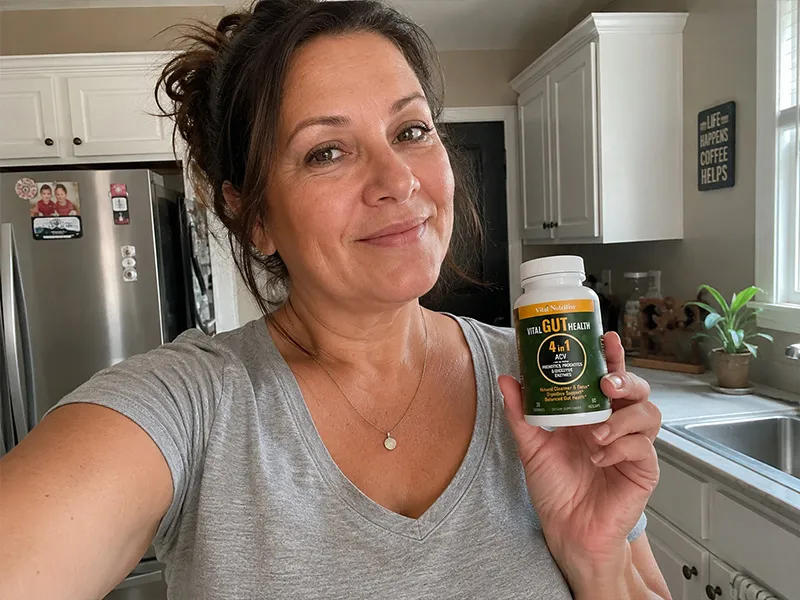
I'm 49, perimenopausal, and on Zepbound — the double slowdown nobody warns you about. My doctor told me to eat more fiber and it made me feel like I'd swallowed wet cement. This is the first thing that made mechanical sense: break the food down instead of adding more bulk. The evening bloat that made me look pregnant by dinner is dramatically better, and I've stopped being afraid of restaurants.

I was skeptical because I'd already wasted over $150 on probiotics and gummies that did absolutely nothing. The difference here is the enzymes — none of the other products I tried addressed the food just sitting in my stomach. What finally clicked for me was the idea of a Metabolic Motility Reset — doing the digestion the medication had switched off. I'm three months in: no more laxative roulette, no more mapping bathrooms at the grocery store. I genuinely forgot what this kind of normal felt like.


Try Vital Gut Health
Risk-Free Today
Formulated specifically for GLP-1 users. Every order includes free shipping and is backed by a 60-day money-back guarantee — no questions asked.
Try It Risk-Free →Common questions from GLP-1 users
Can I take this while still on semaglutide, tirzepatide, or Zepbound?
Will breaking food down faster make my GLP-1 less effective for weight loss?
I have acid reflux — isn't apple cider vinegar the worst thing I could take?
I already tried probiotics and digestive enzymes separately. Why would this be different?
Is this a laxative? Will I get urgency or accidents?
How long before I notice results?

About Dr. James Reynolds
Dr. Reynolds is a board-certified internist with a specialized clinical focus on metabolic and weight-loss medicine. Having prescribed GLP-1 protocols to hundreds of patients, he developed a dedicated nutritional support framework for managing GLP-1 side effects — including the digestive shutdown that affects a significant proportion of patients on semaglutide and tirzepatide. He is committed to ensuring that patients never have to choose between their weight-loss results and a digestive system they can live with.